
Huang's Hail Mary: Nvidia's CEO Ignites AI Arms Race with Bold China Data Center Claim
"Jensen Huang, the visionary CEO of Nvidia, has dropped a bombshell: China can build major AI data centers in days. This audacious statement is not just a pronouncement; it's a strategic gambit, a shot across the bow of competitors, and a potential game-changer in the global AI power struggle. Prepare for a tectonic shift in the industry's landscape as we unpack the implications of Huang's pronouncement."
Key Takeaways
- •Nvidia CEO Jensen Huang claims China can rapidly build major AI data centers, accelerating the AI arms race.
- •This statement underscores Nvidia's central role in the global AI landscape and its strategic challenges in China.
- •The implications extend beyond technology, reshaping geopolitics, economic strategies, and the global power balance.
The desert wind whips across the vast expanse, a digital dust storm mirroring the tempest brewing in the boardrooms of Silicon Valley and the Zhongguancun Science Park. The air crackles with anticipation, the hum of servers a distant promise of untold computational power. This is the new frontier, the arena where the future of artificial intelligence will be forged, and the stakes have never been higher. Jensen Huang, the enigmatic CEO of Nvidia, has just thrown down the gauntlet, claiming China can erect major AI data centers in a matter of days. This is not just a news story; it’s the opening salvo in a war for global technological dominance.
The Lede: A Digital Land Grab
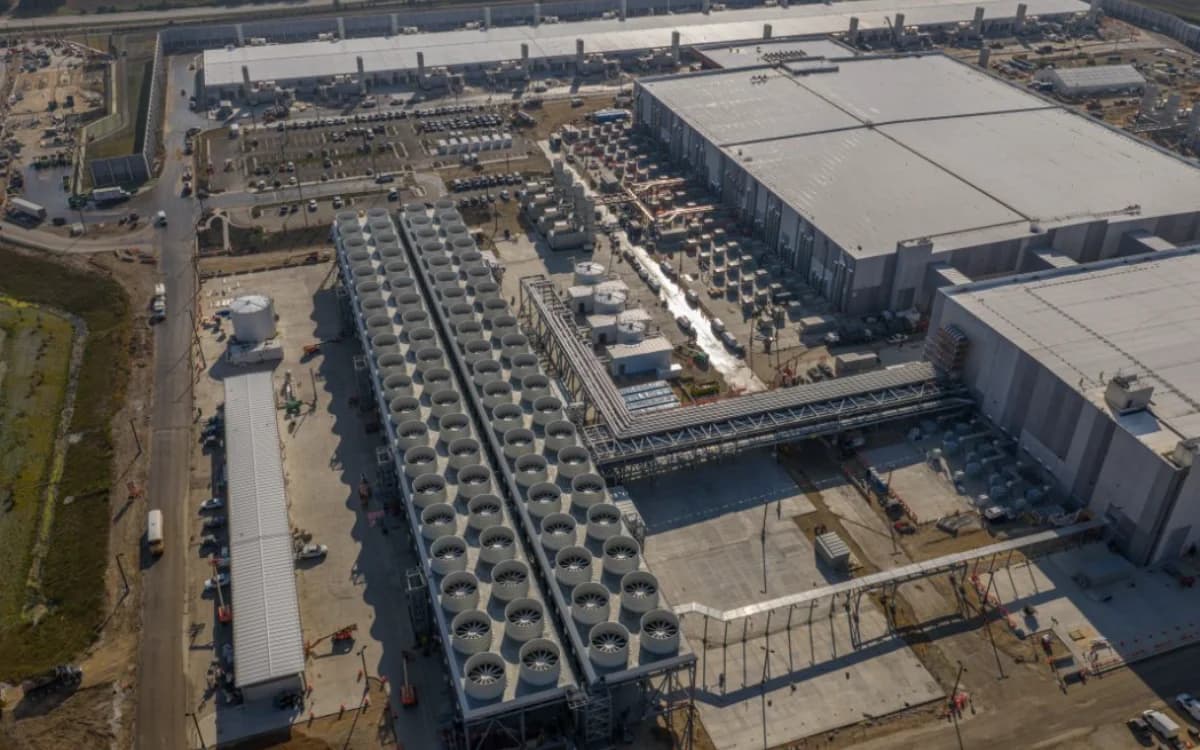
Imagine, if you will, a landscape transformed. The stark desert, once barren, now teeming with the skeletal framework of what will soon be sprawling data centers. These aren't your typical server farms; these are the citadels of the AI revolution, designed to house the cutting-edge GPUs that power the algorithms shaping our world. Huang’s claim, amplified across platforms, including supercarblondie.com, isn't a boast; it's a declaration of intent. It’s the sound of a starting gun, a signal that the race for AI supremacy is accelerating, and the lead horse is making a significant claim. Huang, a man known for his audacious predictions and unwavering confidence, has positioned Nvidia at the epicenter of this whirlwind, and this claim is only the tip of the iceberg.
The Context: From GPUs to Global Dominance
To understand the magnitude of Huang's statement, we must rewind. Nvidia’s journey hasn't been a straight line; it's a rollercoaster ride fueled by innovation and shrewd business acumen. The company’s initial focus on graphics cards for gaming has morphed into a juggernaut in the AI space. The secret weapon? GPUs. Their parallel processing capabilities make them ideally suited for the computationally intensive tasks required by AI. This was no accident; it was a deliberate pivot, a bet placed on the future of computing. This strategic gamble has paid off spectacularly, transforming Nvidia into a dominant force, virtually indispensable to the world's most sophisticated AI endeavors.
The evolution from gaming to AI wasn't instantaneous. It required strategic partnerships, shrewd acquisitions, and an unwavering belief in the potential of parallel processing. Huang, the architect of this transformation, understood the impending convergence of AI and computing before many others. The acquisition of companies specializing in deep learning and AI acceleration, combined with aggressive investment in research and development, fueled the company's meteoric rise. Nvidia didn’t just adapt; it redefined the playing field, making itself the indispensable supplier of AI hardware. This ascent, however, has not been without its challenges. The relentless pursuit of technological advancement has to navigate the complex geopolitical landscape of trade wars, export restrictions, and increasingly competitive national agendas.
The relationship between Nvidia and China has been particularly intricate. China represents a massive market, brimming with potential, but also subject to rigorous government oversight. Access to the Chinese market is crucial for Nvidia, but it also comes with significant caveats, including export controls. Huang's statement about the speed with which China can build data centers should be understood in this context. It's a calculated move, acknowledging China's capabilities while simultaneously asserting Nvidia’s critical role in powering them.
The Core Analysis: Decoding Huang's Message
What does it truly mean to say China can build data centers “in days”? This is where the story gets fascinating. While the precise timeframe is likely an exaggeration, intended for dramatic effect, the core message is clear: China has the resources, the infrastructure, and the ambition to rapidly scale its AI capabilities. This isn't just about faster construction; it's about a highly-developed ecosystem of suppliers, engineers, and government support.
The Strategic Implications: Huang's words serve multiple purposes. First, they are a powerful signal to competitors, reminding them of the scale of China’s commitment. Second, they are a message to Nvidia’s shareholders, reassuring them of the company’s resilience in the face of geopolitical headwinds. Third, it is a rallying cry for the technology community: an acknowledgment of the relentless march forward. His statement also subtly underscores Nvidia’s crucial role. If China can build data centers quickly, it's because Nvidia’s GPUs are the core ingredient. It reinforces the idea that, regardless of any geopolitical barriers, Nvidia remains a central player.
The Numbers Game: The numbers tell the story. The AI data center market is a multi-billion dollar industry, and China is determined to dominate it. The country's commitment is reflected in massive investments in infrastructure, talent development, and research. China's government understands that control over AI equates to control over the future. While the exact details of any agreements are behind closed doors, it is safe to assume that Nvidia’s role in this scenario is under tremendous scrutiny. The question is how fast, how far, and at what price?
The Winners and Losers: In this high-stakes game, the winners are those who control the critical resources. Nvidia, by supplying the GPUs, holds a significant advantage. China, by virtue of its massive market and its aggressive investment, also stands to gain. The losers? Any competitors that fail to keep pace. This is a brutal industry, where only the most innovative and adaptable survive. Other major players like AMD and Intel, are not only competing with Nvidia, but also facing the specter of indigenous Chinese chip manufacturers, backed by state funds. This makes for a perfect storm of challenges, not just for Nvidia, but for any foreign company operating in the Chinese market.
Hidden Agendas: There are always hidden agendas. Huang's statement is undoubtedly intended to shape perceptions, influence policy, and secure Nvidia’s position. It is also an assertion of control and a carefully-calibrated dance between the imperatives of business and the realities of geopolitics. There will be constant pressure from Western governments to limit China's access to advanced technologies. In this scenario, Nvidia has to carefully balance its global ambitions with its ethical and legal obligations.
The Macro View: Reshaping the Global Landscape
Huang’s announcement isn’t just about China. It’s about the broader shift in the global balance of power. The speed at which China can deploy AI data centers is a reflection of its technological prowess and its strategic foresight. This is not simply a technical issue; it's a political, economic, and military one. The country’s commitment to AI is transforming the landscape of global innovation. This will influence everything, from economic growth to military strategy. This moment echoes the shifts of the dot-com era, but the stakes are far, far higher. Whoever controls AI will shape the 21st century.
The Ripple Effect: The implications of this are far-reaching. It will encourage other nations to invest heavily in AI infrastructure. Governments around the world will recognize the importance of AI and will be compelled to act. This will accelerate technological innovation across all sectors, from healthcare to transportation. This will inevitably result in increased competition and potentially lead to new and unforeseen technological breakthroughs.
The Future of Silicon Valley: The traditional dominance of Silicon Valley is facing a challenge. The rapid rise of China's AI capabilities could result in a shift of talent and investment towards Asia. This doesn't mean the end of Silicon Valley, but it will require significant adaptation. The region will need to maintain its edge by focusing on innovation, attracting top talent, and fostering a collaborative environment. This will be critical for retaining its position at the forefront of the technological frontier.
The Verdict: A New Era Dawns
1-Year Outlook: Expect the AI arms race to intensify. China will continue to pour resources into building AI infrastructure. Nvidia, and its competitors, will remain at the center of the storm. The geopolitical tensions surrounding AI will escalate, leading to increased regulation and scrutiny.
5-Year Outlook: The global AI landscape will be fundamentally transformed. China will emerge as a major player, potentially rivaling the United States in its AI capabilities. New AI applications will proliferate, transforming industries and societies. Competition for talent, resources, and market share will be fierce.
10-Year Outlook: AI will be deeply integrated into every aspect of our lives. The countries that master AI will define the future. The geopolitical landscape will be reshaped, with AI playing a central role in both economic prosperity and military dominance. Nvidia will be judged on its ability to navigate the complex challenges it faces today, and to maintain its position at the cutting edge of AI.
Huang’s claim that China can build major AI data centers in days is not just a statement; it's a strategic move. It is a calculated assessment of the challenges and opportunities in the world of artificial intelligence. It's an opening shot in a global chess match. It's a reminder that the future is being built today, one data center, one chip, one line of code at a time.