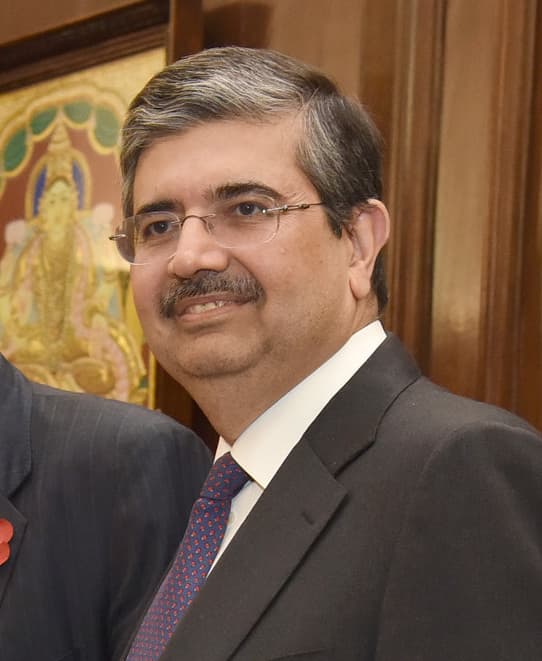
Billionaire Profile
Uday Kotak
Global Rank
#148

Image: Public domain | via Wikimedia Commons

Uday Kotak

CEO, Kotak Mahindra Bank
IN
Real-Time Net Worth
$15B
As of December 2025
Age
66
Source
Banking
Industry
finance-investments
Citizenship
IN

Biography

Uday Kotak, born in 1959, is an Indian billionaire banker and the visionary founder of Kotak Mahindra Bank. He transformed a small finance firm into one of India's leading private sector banks, demonstrating exceptional acumen in the finance and investment industry. His career spans decades, marked by strategic decisions, including the acquisition of ING Vysya Bank, and a commitment to innovation and risk management. Kotak's leadership has been globally recognized, earning him prestigious awards and positioning him as a key figure in shaping India's financial landscape. As of 2024, his net worth is estimated at $15.0 billion, a testament to his successful career in banking and investments. He is married and has two children.

Wealth Over Time

In-Depth Profile

Early Life

Uday Suresh Kotak was born on March 15, 1959, in Mumbai, India, into an upper-middle-class Gujarati Hindu Lohana family involved in cotton trading. He grew up in a large joint family, a household of 60 people, which he described as "Capitalism at work and Socialism at home". His early interests included cricket and playing the sitar, though he no longer plays the sitar. His aptitude for mathematics influenced his career path. He completed his Bachelor's degree in Commerce from Sydenham College and earned an MBA from Jamnalal Bajaj Institute of Management Studies.

Rise to Success

Kotak began his career in the early 1980s when India's economy was still relatively closed. He chose to start his own business instead of accepting a job with a multinational corporation. In 1985, he founded Kotak Capital Management Finance Ltd., which later became Kotak Mahindra Finance Ltd.. The company initially focused on bill discounting. Over the years, Kotak diversified into various financial services, including stockbroking, investment banking, and car finance. A significant milestone was achieved in 2003 when Kotak Mahindra Finance Ltd. became the first non-banking finance company in India to receive a banking license, transforming into Kotak Mahindra Bank. Another key moment in his career was the acquisition of ING Vysya Bank in 2014, which boosted Kotak Mahindra Bank's market position.

Key Business Strategies

Uday Kotak's leadership style is characterized by a visionary yet risk-conscious approach. He emphasized long-term strategy, innovation, and strong risk management. Kotak focused on building a strong, customer-focused financial institution tailored to the needs of the Indian market. His ability to balance growth with caution positioned the bank as a resilient institution during economic uncertainties. The launch of the 811 digital savings account highlights his embrace of technology and digital transformation.

Philanthropy

Kotak's vision for equitable prosperity extends beyond financial services. The Kotak Education Foundation focuses on alleviating poverty through education and livelihood programs, working with economically underprivileged communities in India.

Career Milestones

1985

Founded Kotak Capital Management Finance Ltd.

Started the financial firm with an initial focus on bill discounting.

2003

Kotak Mahindra Finance Ltd. became Kotak Mahindra Bank

Became the first non-banking finance company in India to receive a banking license.

2014

Acquired ING Vysya Bank

Boosted Kotak Mahindra Bank's market position through acquisition.

2023

Stepped down as CEO of Kotak Mahindra Bank

Transitioned to a non-executive director role.

Philanthropy & Social Impact

Education and Livelihoods

Kotak Education Foundation

$XB

Focuses on alleviating poverty through education and livelihood programs in underprivileged communities.

Business Philosophy & Leadership

Notable Quotes

"Things change so fast, you can't afford to be complacent."

Leadership Principles

Vision-orientation

Focusing on long-term strategy rather than short-term targets.

Risk-sensitive

Maintaining a reputation for prudent lending and financial management.

Innovation

Embracing new products and digital channels.

Humility in success

Remaining accessible despite significant achievements.