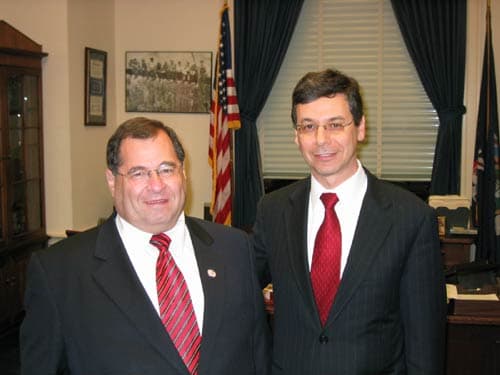
Billionaire Profile
Daniel Nadler
Global Rank
#992

Image: Public domain | via Wikimedia Commons

Daniel Nadler

CEO, OpenEvidence
CA
Real-Time Net Worth
$3.6B
As of December 2025
Age
42
Source
AI software
Industry
technology
Citizenship
CA

Biography

Daniel Nadler (born 1983) is a Canadian-born billionaire entrepreneur and poet. He is the founder of OpenEvidence, an AI-powered medical information platform that has become the default operating system for medical knowledge in the United States. Nadler's estimated net worth is $3.6 billion. His source of wealth stems from his involvement in AI software, particularly in the healthcare sector. Nadler's career includes co-founding Kensho Technologies, an AI company later acquired by S&P Global, and producing the film *Palmer*. He holds a PhD from Harvard University and is also a published poet. OpenEvidence, launched in 2022, helps doctors make high-stakes decisions at the point of care.

Wealth Over Time

In-Depth Profile

Early Life

Daniel Nadler was born in Toronto, Ontario, Canada, in 1983. He is the son of immigrants from Poland and Romania. Nadler attended Harvard University, where he studied mathematics and classics, and poetry under the mentorship of Pulitzer Prize winner Jorie Graham. He also served as a visiting scholar at the Federal Reserve during his PhD studies. In 2016, Nadler received a PhD from Harvard with a doctoral thesis on the pricing mechanisms of credit derivatives.

Rise to Success

In 2013, while still a PhD student, Nadler co-founded Kensho Technologies. The AI company developed machine learning systems for financial analysis. Kensho was acquired by S&P Global in 2018 for $550 million. Nadler then founded OpenEvidence in 2022, an AI company focused on the medical field. OpenEvidence provides an AI copilot for doctors to help them make high-stakes decisions. The company has rapidly grown and is used by approximately 40% of U.S. physicians. OpenEvidence's valuation reached $6 billion after a funding round in October 2025.

Key Business Strategies

Nadler's key business strategy involves leveraging AI to provide solutions in high-stakes fields. OpenEvidence utilizes an ad-supported model, allowing it to provide its services free to doctors. The AI platform is designed to provide doctors with precise, evidence-backed answers from peer-reviewed medical literature. Nadler has emphasized the importance of building trust, focusing on human-written answers and routing doctors to primary sources like the New England Journal of Medicine.

Philanthropy

Information on Daniel Nadler's specific philanthropic activities and amounts is limited in the search results. However, his work with the Academy of American Poets suggests an interest in supporting the arts.

Career Milestones

2013

Co-founded Kensho Technologies

An AI company focused on financial analysis.

2016

Published poetry collection

Published debut poetry collection, 'Lacunae: 100 Imagined Ancient Love Poems'.

2018

Kensho Acquired by S&P Global

Kensho was acquired for $550 million.

2018

Elected to the Board of Directors of the Academy of American Poets

Became the youngest person ever elected to the Academy's Board.

2021

Founded OpenEvidence

Founded OpenEvidence, an AI company focused on the medical field.

2025

Named to TIME100 Health list

Recognized as one of the 100 most influential people in global health.

Philanthropy & Social Impact

Arts

Academy of American Poets

Information unavailable

Involved in the arts through his board membership

Business Philosophy & Leadership

Notable Quotes

""Artificial intelligence is a misnomer. It's accelerated intelligence.”"

"“I think OpenEvidence looks like it's going to be for healthcare what Google was for the Internet,”"

Leadership Principles

Focus on high-stakes decisions

Develop AI solutions for areas like healthcare where decisions have significant consequences.

Treating knowledge workers as consumers

Design products that meet the needs of a knowledgeable audience.

Prioritize human-written answers

Ensure the system primarily surfaces human-written answers to users.