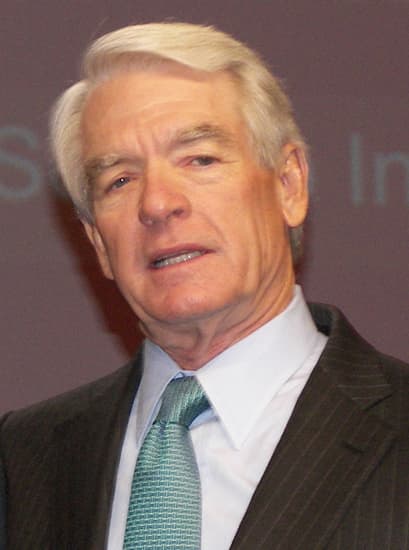
Billionaire Profile
Charles Schwab
Global Rank
#203

Image: Public domain | via Wikimedia Commons

Charles Schwab

CEO, Charles Schwab Corporation
US
Real-Time Net Worth
$12.8B
As of December 2025
Age
88
Source
Discount brokerage
Industry
finance-investments
Citizenship
US

Biography

Charles Schwab is an American investor and financial executive, best known as the founder and chairman of the Charles Schwab Corporation, a leading financial services company. Born on July 29, 1937, he has a current estimated net worth of $12.8 billion. Schwab pioneered the discount brokerage model, revolutionizing the investment landscape by making it more accessible. His career includes founding Investment Indicator in 1963, incorporating First Commander Corporation in 1971, and leading Charles Schwab & Co., Inc. He has been recognized with numerous accolades and has authored several investment books. He is known for his commitment to clients and dedication to helping people achieve their financial goals. Schwab's contributions have significantly shaped the financial services industry, making him a prominent figure in the world of finance.

Wealth Over Time

In-Depth Profile

Early Life

Charles Robert Schwab Sr. was born on July 29, 1937, in Sacramento, California. He grew up in Woodland, California, before moving to Santa Barbara at age 12. In his youth, he worked various jobs, including as an ice cream salesman and a caddie. He attended Santa Barbara High School and was captain of the golf team. Schwab graduated from Stanford University in 1959 with a Bachelor of Arts in Economics and earned his Master of Business Administration from Stanford Graduate School of Business in 1961.

Rise to Success

Schwab's career began with the investment newsletter, Investment Indicator, in 1963. In 1971, he incorporated First Commander Corporation to offer traditional brokerage services. The company's name changed to Charles Schwab & Co., Inc. in 1973. A pivotal moment arrived in 1975 when the U.S. Securities and Exchange Commission deregulated the securities industry, allowing firms like Schwab to set their own fees. Schwab seized the opportunity to offer discount brokerage services, opening the first branch in Sacramento, CA, in September 1975. This strategy was a major success, and Schwab quickly became the largest discount broker in the United States.

Key Business Strategies

Schwab's business model was built on the principle of putting the client first. He focused on providing low-cost, efficient services, along with 24/7 access to services, and the one-stop mutual fund supermarket. The company expanded its offerings to include a wide range of financial products and services, catering to retail investors, independent advisors, and institutional clients. Schwab’s strategic focus on client acquisition and retention has driven consistent growth.

Philanthropy

Schwab is involved in philanthropy through the Charles and Helen Schwab Foundation. The foundation supports education, housing, and employment initiatives that aim to improve the economic well-being of marginalized communities. In 2024, the Charles Schwab Foundation granted $15.4 million and provided financial literacy programs benefiting 1.8 million youth.

Career Milestones

1959

Graduated from Stanford University

Earned a Bachelor of Arts in Economics.

1961

Graduated from Stanford Graduate School of Business

Earned a Master of Business Administration.

1963

Founded Investment Indicator

Launched an investment newsletter.

1971

Founded First Commander Corporation

To offer traditional brokerage services.

1973

Charles Schwab & Co., Inc.

The company's name was changed.

1975

Opened first branch in Sacramento, CA

Began offering discount brokerage services.

2008

Stepped down as CEO

Remained Chairman of the Charles Schwab Corporation.

Philanthropy & Social Impact

Education, Housing, Employment

Charles and Helen Schwab Foundation

Not specified

Supports education, housing, and employment initiatives for marginalized communities.

Business Philosophy & Leadership

Notable Quotes

"Always put the client first. No matter what."

Leadership Principles

Client-First Approach

Prioritizing clients' needs and goals in all business decisions and operations.

Innovation

Continuously seeking new ways to provide better value and a better experience for clients.

Integrity

Conducting business with honesty and ethical standards.